
The software engineering landscape of 2026 has fundamentally shifted. We have officially moved past the era of relying on massive, monolithic prompts fed into a single Large Language Model. The sheer complexity of modern distributed systems, coupled with the intricate requirements of enterprise-grade security and scalable architectures, demands a paradigm shift. This new standard is the orchestrated multi-agent swarm. By distributing cognitive load across specialized, narrowly scoped AI agents, engineering teams can achieve unparalleled levels of precision, speed, and reliability. At the very forefront of this evolutionary leap is Ruflo, a groundbreaking framework that utilizes a 'Hive Mind' architecture to deploy and manage highly specialized, Claude-powered agents. These agents do not just generate boilerplate text; they collaborate in real-time, review each other's abstract syntax trees, negotiate complex architectural decisions, and autonomously drive the entire software development lifecycle from a simple set of high-level requirements to a production-ready repository in minutes.
The Shift to Swarm Intelligence
For years, the industry relied on zero-shot or few-shot prompting techniques to force a single model to act as a full-stack developer, security auditor, and QA engineer simultaneously. While impressive in the early 2020s, this approach quickly hit a ceiling when confronted with enterprise-scale repositories. Complex software engineering requires maintaining state across multiple files, adhering to strict compliance frameworks, and iteratively resolving dependency conflicts.
Why Single Agents Fail at Scale
When a single agent is tasked with architecting a system, writing the code, and testing it, it inevitably suffers from context degradation. As the context window fills with implementation details, the agent loses track of the overarching architectural constraints. Furthermore, single agents lack an internal feedback loop. If a single agent writes a vulnerable piece of code, it is unlikely to catch its own mistake during a self-review phase because the same neural pathways that generated the error are being used to evaluate it. This phenomenon, known as the 'hallucination loop', requires a structural solution rather than just larger context windows. Multi-agent swarms solve this by introducing adversarial and collaborative dynamics. By assigning rigid, independent personas to separate model instances, we create a system of checks and balances that mimics a real-world engineering team.
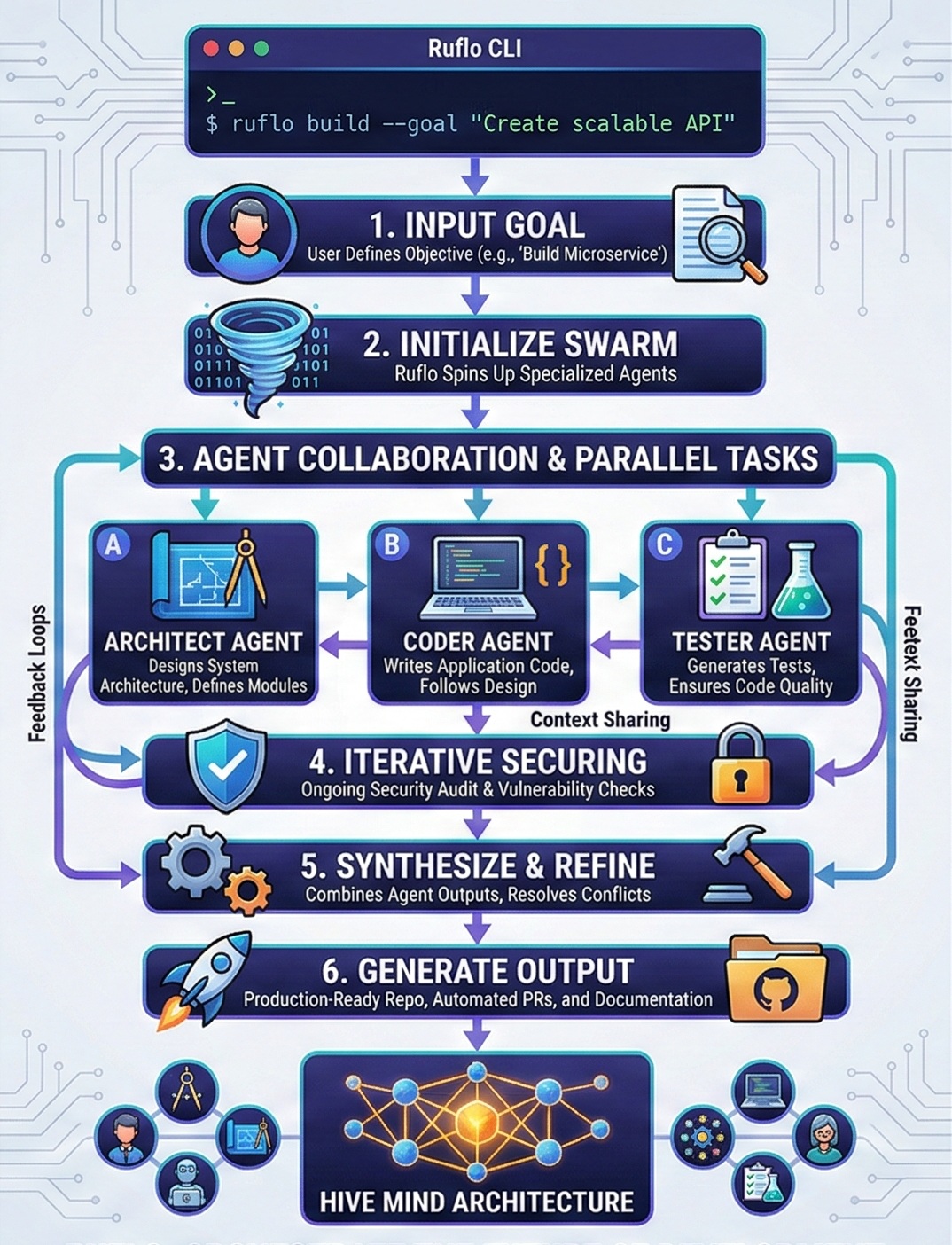
Enter Ruflo The Hive Mind Architecture
Ruflo emerges as the definitive framework for orchestrating these complex, multi-agent interactions. Unlike earlier orchestration libraries that relied on linear, step-by-step chains, Ruflo introduces a non-linear, event-driven architecture called the Hive Mind. The Hive Mind acts as a centralized message bus and state manager, allowing agents to subscribe to relevant events, interrupt each other, and spin up sub-threads for deep-dive collaborative sessions.
Key Features of the Ruflo Ecosystem
Ruflo is built on several foundational pillars that distinguish it from legacy autonomous agents. Understanding these features is critical to designing swarms that can handle production workloads.
- Distributed Cognitive Load: Ruflo allows developers to instantiate agents with highly specific system prompts and tool access. A Security Agent only cares about vulnerabilities, while a Developer Agent focuses strictly on algorithmic efficiency and feature implementation.
- Deterministic State Management: Using a high-performance Redis-backed vector state, Ruflo ensures that agents never suffer from amnesia. Every conversation, code snippet, and architectural diagram is embedded and stored, allowing agents to retrieve historical context instantly.
- Real-Time Collaboration Channels: Agents in a Ruflo swarm do not just wait for their turn. They can open synchronous collaboration channels to pair-program, dramatically reducing the time required to resolve compilation errors or logic bugs.
- Native Infrastructure Integration: Ruflo agents come pre-equipped with capabilities to spin up isolated Docker containers, execute shell commands safely, parse abstract syntax trees (ASTs), and directly interact with version control systems.
Architecting Your First Autonomous Swarm
To understand the power of Ruflo, we must look at how a swarm is constructed. The core abstraction in Ruflo is the HiveMind, which acts as the central nervous system for your agents. By configuring the environment and registering specialized agents powered by the latest Claude models, you create a dedicated autonomous team.
import os
import asyncio
from ruflo.core import HiveMind, SwarmConfig
from ruflo.agents import ArchitectAgent, DeveloperAgent, SecurityAgent, QAAgent
from ruflo.models import Claude3_5_Opus, Claude3_5_Sonnet

async def initialize_dev_swarm():
    # Configure the Hive Mind environment with state persistence
    config = SwarmConfig(
        project_name="distributed-payment-gateway",
        max_iterations=100,
        memory_backend="redis-vector",
        telemetry_enabled=True
    )

    hive_mind = HiveMind(config=config)

    # Define the specialized agents with specific Claude models
    architect = ArchitectAgent(
        name="Alice",
        model=Claude3_5_Opus(temperature=0.2),
        system_prompt="You are a Staff Cloud Architect. Design robust, scalable microservices ensuring high availability."
    )

    developer = DeveloperAgent(
        name="Bob",
        model=Claude3_5_Sonnet(temperature=0.4),
        supported_languages=["python", "rust"],
        auto_execute=True
    )

    security = SecurityAgent(
        name="SecOps-Sam",
        model=Claude3_5_Opus(temperature=0.1),
        strict_mode=True, # Will reject any code with critical CVEs
        tools=["bandit", "semgrep"]
    )

    # Register agents to the Hive Mind message bus
    hive_mind.register_agents([architect, developer, security])

    return hive_mind
Decoupling Roles with Specialized Agents
In the initialization script above, we define three distinct personas, carefully selecting the underlying model based on the complexity of their role. Alice, the Architect, uses the heavyweight Claude Opus model with a low temperature setting, ensuring her architectural designs are highly deterministic, logical, and deeply reasoned. Bob, the Developer, utilizes the Claude Sonnet model, which is optimized for rapid code generation and iteration. SecOps-Sam, functioning as the ultimate gatekeeper, employs Opus alongside native AST parsing tools like Bandit and Semgrep to ensure zero vulnerable code makes it to production. By mapping models to roles based on parameter size and speed, Ruflo optimizes token economics while maximizing output quality.
Automating the Complete Development Lifecycle
Once the roster is built and registered to the HiveMind, we can orchestrate the actual software development lifecycle. Ruflo excels at taking highly ambiguous requirements and systematically refining them into production-ready code through multi-agent orchestration.
async def execute_development_lifecycle(hive_mind, requirements_doc):
    print("Initiating Ruflo Swarm Intelligence...")

    # Step 1: Architectural Planning
    architecture_spec = await hive_mind.dispatch(
        task="Analyze the requirements and output a system architecture document with OpenAPI specs.",
        assignee="Alice",
        context=requirements_doc
    )

    # Step 2: Code Generation
    source_code = await hive_mind.dispatch(
        task="Implement the microservices strictly following the OpenAPI spec.",
        assignee="Bob",
        context=architecture_spec
    )

    # Step 3: Security Review and Refactoring (Synchronous Collaboration)
    audit_report = await hive_mind.collaborate(
        participants=["Bob", "SecOps-Sam"],
        task="Review the source code for OWASP vulnerabilities. Bob must patch any issues found by SecOps-Sam until approved.",
        context=source_code
    )

    # Step 4: Automated Commit and Pull Request
    repo = await hive_mind.tools.github.create_pr(
        title="feat: Initial Payment Gateway Implementation",
        code=audit_report.final_code,
        reviewers=["Alice"] # Architect does the final code review
    )

    print(f"Deployment ready. PR created at: {repo.pr_url}")

# Execution entry point
requirements = "Build a PCI-DSS compliant payment gateway using FastAPI, SQLAlchemy, and PostgreSQL."
# asyncio.run(execute_development_lifecycle(initialize_dev_swarm(), requirements))
The Architectural Planning Phase
When the dispatch method is called for Alice, Ruflo provisions a sandboxed reasoning environment. Alice breaks down the unstructured requirements into a structured JSON representation of the system. She generates OpenAPI specifications, defines the database schemas, and outlines the required API endpoints. Because her output is routed through the HiveMind memory backend, it becomes a permanent contextual anchor for the rest of the swarm. If Bob later attempts to use an undocumented third-party library that violates the architecture, the Hive Mind can flag the deviation immediately.
Real-Time Collaboration and Secure Coding
The most powerful method in the Ruflo API is collaborate. Unlike a standard dispatch, which is a fire-and-forget asynchronous call, collaborate spins up a synchronous WebSockets-based channel between two or more agents. In our lifecycle example, Bob and SecOps-Sam enter a tight feedback loop. Bob proposes an implementation for the payment processing endpoint. SecOps-Sam intercepts the payload, runs a simulated Semgrep scan, and detects a potential SQL injection vulnerability in the raw SQLAlchemy query. Instead of failing the entire pipeline, SecOps-Sam sends a targeted message back to Bob detailing the flaw. Bob autonomously rewrites the function to use parameterized queries and resubmits it. This adversarial process happens in milliseconds, completely isolated from human intervention, ensuring that the resulting codebase is battle-hardened.
Automated Testing and Repository Generation
Once consensus is reached in the collaboration channel, Ruflo packages the verified abstract syntax trees and raw code strings into an artifact. The framework's native infrastructure integrations allow it to autonomously clone the target repository, apply the diffs, stage the commits, and push the branch to a remote server. The API call to create_pr interfaces directly with GitHub, generating a comprehensive pull request description that summarizes the architectural decisions Alice made, the implementation details Bob wrote, and the security audits SecOps-Sam performed.
Under the Hood of the Ruflo Message Bus
The true magic of Ruflo lies in its proprietary Inter-Agent Message Bus. This bus is what allows agents to break out of the rigid, conversational turn-taking that defined older frameworks. Built on top of a high-throughput publisher/subscriber model, the bus routes context and state mutations globally.
Synchronous Threads vs Asynchronous PubSub
Ruflo supports two primary modes of inter-agent communication. The asynchronous PubSub mode is used for global broadcasting. For instance, when Alice finalizes the architecture, she publishes a SpecFinalizedEvent. Any agent subscribed to that topic—such as a dynamically spun-up QA Agent—can immediately begin writing unit tests in the background while Bob writes the source code. Conversely, synchronous threads are utilized when agents must block execution until a consensus is reached, such as during a severe security audit where the build pipeline must halt until a vulnerability is patched.
Designing Custom Conflict Resolution
In any high-functioning multi-agent team, disagreements are inevitable. A common scenario involves a Developer Agent attempting to introduce a highly performant but complex caching layer, while the Security Agent rejects it due to cache-poisoning risks. Ruflo handles deadlocks through an extensible ConflictResolver system.
from ruflo.bus import ConflictResolver

class ArchitectOverrideResolver(ConflictResolver):
    def resolve(self, agent_a_state, agent_b_state, history):
        # Check if the deadlock involves Developer and Security
        if agent_a_state.role == "security" and agent_b_state.role == "developer":
            print("Deadlock detected. Escalating to Staff Architect...")
            # Inject the current deadlock history into Alice's context
            return self.escalate_to("Alice", payload={
                "issue": "Security and Implementation conflict",
                "history": history.get_last_n_messages(10)
            })

        # Fallback to standard token-weighted consensus
        return self.default_consensus(agent_a_state, agent_b_state)

# Apply the custom resolver to the Hive Mind configuration
config.conflict_resolver = ArchitectOverrideResolver()
State Rollbacks and Context Injection
When a conflict triggers an escalation, Ruflo does not simply pass a raw error string to the Architect. The framework utilizes advanced state rollbacks. It queries the vector database to identify the exact commit or context window where the architectural intent diverged from the implementation reality. Ruflo unwinds the state matrix, packages the conflicting ASTs and vulnerability reports into a unified payload, and injects it into Alice's processing queue. Alice can then issue a definitive ruling—either overriding the security constraint if it is a false positive, or instructing Bob to implement a specific mitigation strategy. This hierarchical conflict resolution precisely mirrors the operational dynamics of elite human engineering teams, enabling swarms to navigate extreme technical ambiguity.